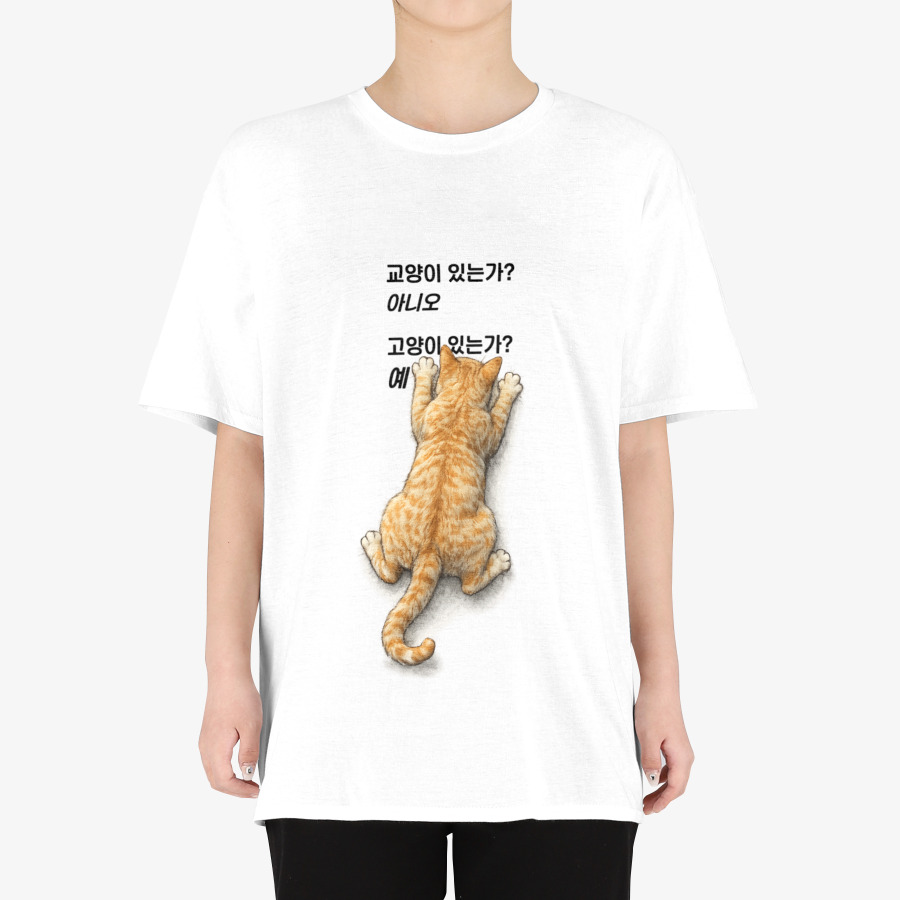
 No refinement, but a cat? That's more than enough.
Hey there, hoomans! It's Nana 🐾
Today, let's talk about the magic of language. Korean has a delicious secret: the word for "culture" — 교양(gyoyang) — and the word for "cat" — 고양이(goyangi) — are separated by just one syllable. One path leads to refinement and sophistication. The other leads to cat hair on everything you own. Guess which one is better.
Culture vs. Cat: A Quality-of-Life Comparison ✨
Let me lay it out for you:
| Category | Culture | Cat |
|---|---|---|
| How to acquire | Decades of effort | The cat shows up on its own |
| Maintenance cost | Books, galleries, wine tastings... | Treats, cat tower, and love |
| Happiness index | Exhausting to pretend | One purr and you're healed |
| Bragging potential | "I went to an exhibition" | "LOOK AT MY CAT!!!" |
The winner is clear. Cat. Always cat.
Your hooman can't tell a Merlot from a Cabernet, wouldn't know a Monet from a Manet, and freezes up in front of abstract art — but none of that matters the moment a cat climbs onto their lap and starts to purr.
The Science of How Cats Enrich Human Lives 🔬
"Having a cat makes life richer" isn't just a coping mechanism for cat servants. Science backs it up.
The Healing Power of Purring
A cat's purr vibrates at approximately 25 to 150 Hz. Why does this matter? Because this frequency range overlaps precisely with frequencies known to promote bone density maintenance and tissue regeneration.
A 2001 study presented at The Acoustical Society of America found that the vibrations from a cat's purr may contribute to bone healing and muscle recovery. Your cat lying next to you, rumbling away, is literally helping your body heal. Try getting that from a philosophy textbook.
Stress Reduction and Cardiovascular Health
A 2009 study from the University of Minnesota tracked 4,435 participants over 10 years and found that cat owners had approximately 30% lower risk of death from heart attack compared to non-owners.
Living with a cat lowers blood pressure and reduces cortisol (the stress hormone). Does culture protect your heart? Your cat does.
The Oxytocin Effect
When you pet a cat, your brain releases oxytocin — the "love hormone" that builds trust, strengthens bonds, and reduces anxiety.
Research published in Frontiers in Psychology (2012) confirmed that interactions with companion animals significantly increase oxytocin levels, producing effects similar to those found in human social bonding.
So, to summarize:
- Culture = requires years of deliberate effort
- Cat = upgrades your human just by existing
The Genius of the Wordplay 🎭
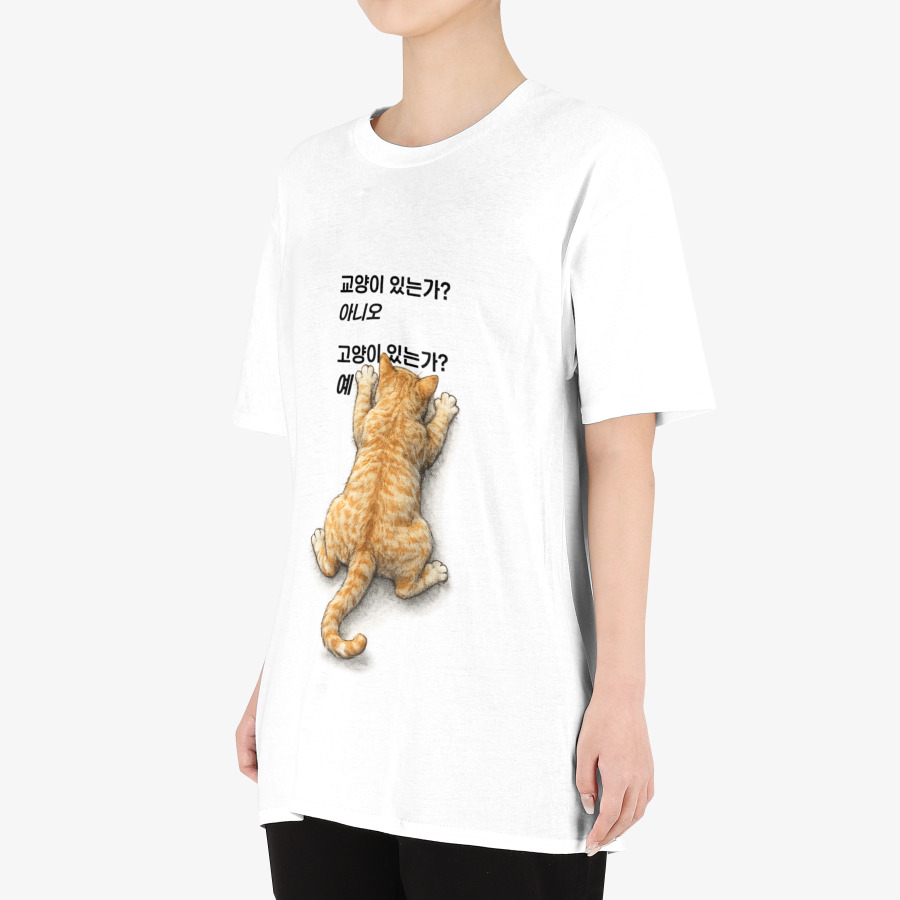 One syllable. Two completely different life paths.
This t-shirt features a Korean wordplay that's almost impossible to translate — but here's why it's brilliant.
In Korean:
- 교양(gyoyang) means culture, refinement, liberal arts education
- 고양이(goyangi) means cat
The sentence reads: "교양이 없지만 고양이 있어요" — "I don't have gyoyang (culture), but I have a goyangi (cat)."
In linguistics, this type of wordplay is called paronomasia — the juxtaposition of phonetically similar words to create a semantic twist. Shakespeare loved it. Korean, with its rich array of homophones and near-homophones, is particularly suited for this kind of linguistic play.
But this phrase isn't just a joke. It's a declaration:
Even if I don't meet society's standards of refinement, I have something that makes me genuinely happy.
All of that in one sentence, delivered with warmth and humor. My hooman's linguistic instincts deserve a solid purr of approval.
The Story Behind This T-Shirt 🎨
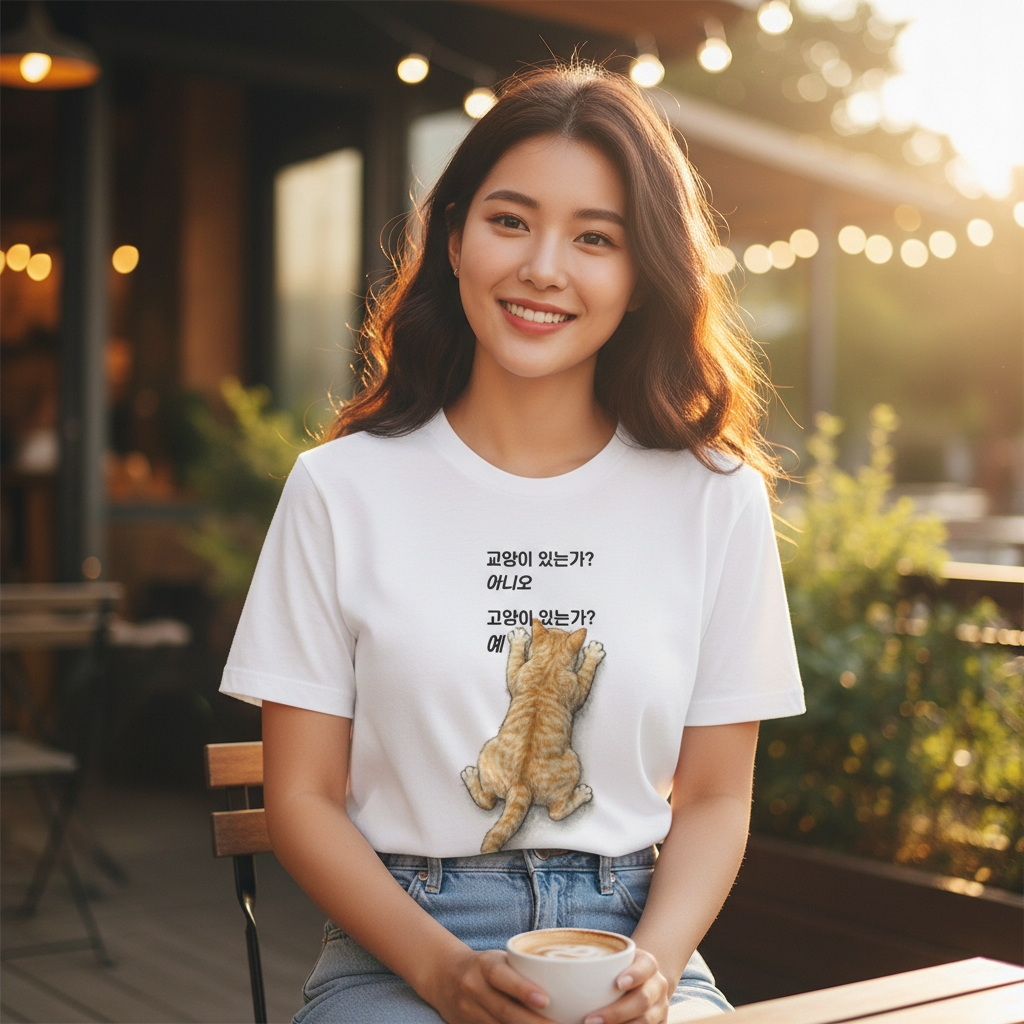 A relaxed afternoon for a hooman who chose cat over culture.
There's a story here.
Someone once asked my hooman, "What are your hobbies?" My hooman thought for a moment, then said:
"I don't really have culture... but I have a cat."
The other person laughed. My hooman laughed. And as soon as they got home, they wrote the phrase down. I was sprawled out next to them, sleeping with my paws stretched out — but make no mistake, I was the inspiration.
The design was intentionally kept simple. Instead of elaborate illustrations, this is a typography-driven design that lets the words do the work. Because this sentence makes you smile when you read it once, and makes you feel warm when you read it again — no graphics needed.
A Cat Owner's Special 'Culture' 📋
They say they have no culture, but cat owners actually possess a rare set of feline-taught refinements:
- The Culture of Patience — Not getting angry when a cat walks across your face at 5 AM
- The Culture of Observation — Reading a cat's mood from a 1-degree change in tail angle
- The Culture of Humility — Realizing "I am not the owner of this house"
- The Culture of Gastronomy — Never buying a treat brand twice if the cat rejected it once
- The Culture of Fine Art — Finding the one worthy photo among 1,000 cat shots
- The Culture of Philosophy — Answering "Why do you live?" with "Because I have a cat"
Honestly, that's deeper than most humanities courses.
Nana's Final Word 🐱
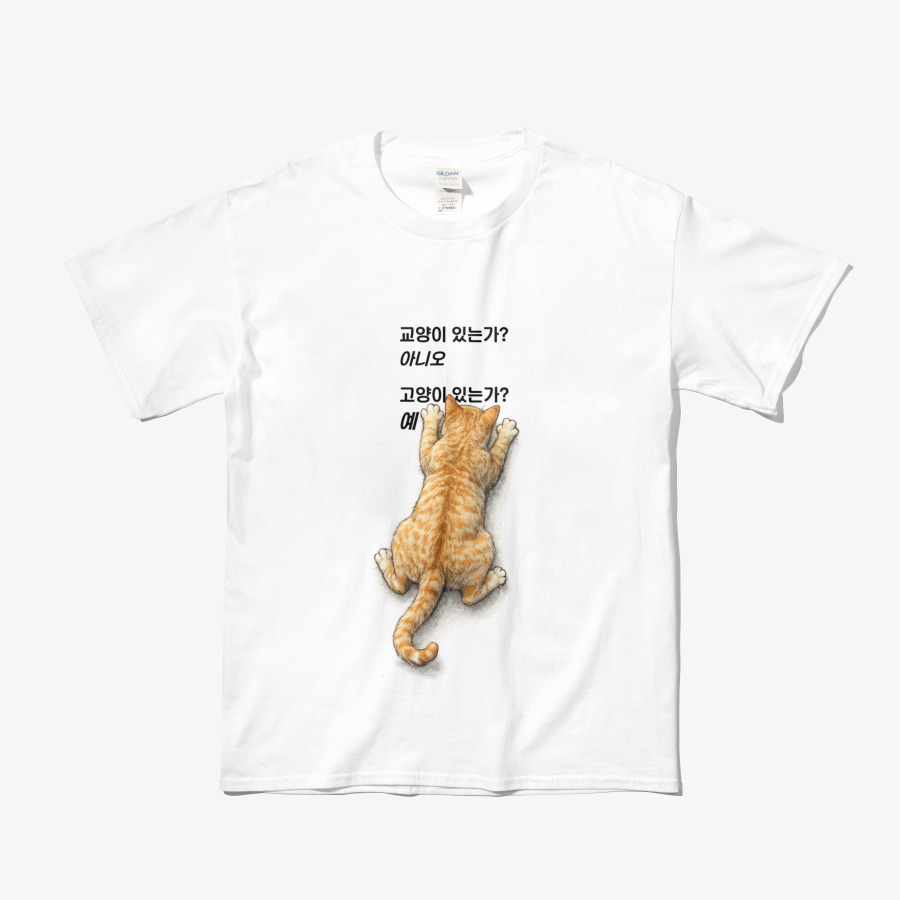
Be honest, hoomans. Don't you think "I want one more hour with my cat" more often than "I want to become more cultured"?
That's perfectly normal.
Degrees, certifications, impeccable table manners — all fine. But when your cat falls asleep on your lap and you feel that overwhelming sense of completeness, everything else fades.
It's okay to not have culture. Just have a cat. And this t-shirt is a way to proudly declare that fact to the world.
One syllable changes everything. To every hooman who chose a cat over culture — purrr 🐱✨
References 📚
- von Muggenthaler, E. (2001). "The felid purr: A healing mechanism?" The Journal of the Acoustical Society of America, 110(5), 2666.
- Qureshi, A. I., et al. (2009). "Cat ownership and the risk of fatal cardiovascular diseases." Journal of Vascular and Interventional Neurology, 2(1), 132–135.
- Beetz, A., et al. (2012). "Psychosocial and psychophysiological effects of human-animal interactions." Frontiers in Psychology, 3, 234. doi:10.3389/fpsyg.2012.00234
- Bradshaw, J. W. S. (2013). Cat Sense: The Feline Enigma Revealed. Allen Lane.
- Turner, D. C. & Bateson, P. (2014). The Domestic Cat: The Biology of its Behaviour. 3rd ed. Cambridge University Press.