 Welcome to the jungle… I mean, the cat tower. 🎸
Hey there, hoomans! It's Nana 🐾
Today's story is going to be loud. It's about rock 'n' roll. Well, more precisely — it's about the day cats took over rock 'n' roll.
My hooman was working one afternoon with Guns N' Roses' Appetite for Destruction blasting from the speakers. "Welcome to the Jungle" was shaking the walls when I yawned from the top of my cat tower and stared down at them. My hooman looked up at me and burst out laughing.
"You look like a total rock star."
Purrrr. Obviously. I was born one.
Cats Were Always Rock Stars 🎤
This isn't a joke. Think about it seriously. The overlap between cats and rock stars is uncanny.
| Category | Rock Star | Cat |
|---|---|---|
| Schedule | Active at night, sleeps during the day | 4 AM zoomies, 16 hours of daytime naps |
| Stage presence | Appears to ignore the audience | Actually ignores the hooman |
| Destructive tendencies | Smashes hotel rooms | Shreds cat towers, sofas, and curtains |
| Vocals | Sings until dawn | Howls until dawn |
| Fan management | Fan service only when they feel like it | Affection only when they feel like it |
| Fashion | Leather jacket + sunglasses | Natural fur coat + dilated pupils |
A 2019 study in Current Biology found that cats clearly recognize their own names but sometimes choose not to respond. This isn't indifference — it's selective ignoring. Exactly the same energy as a rock star walking off stage mid-encore. Legends only.
Meet the Three Band Members 🐱🐱🐱
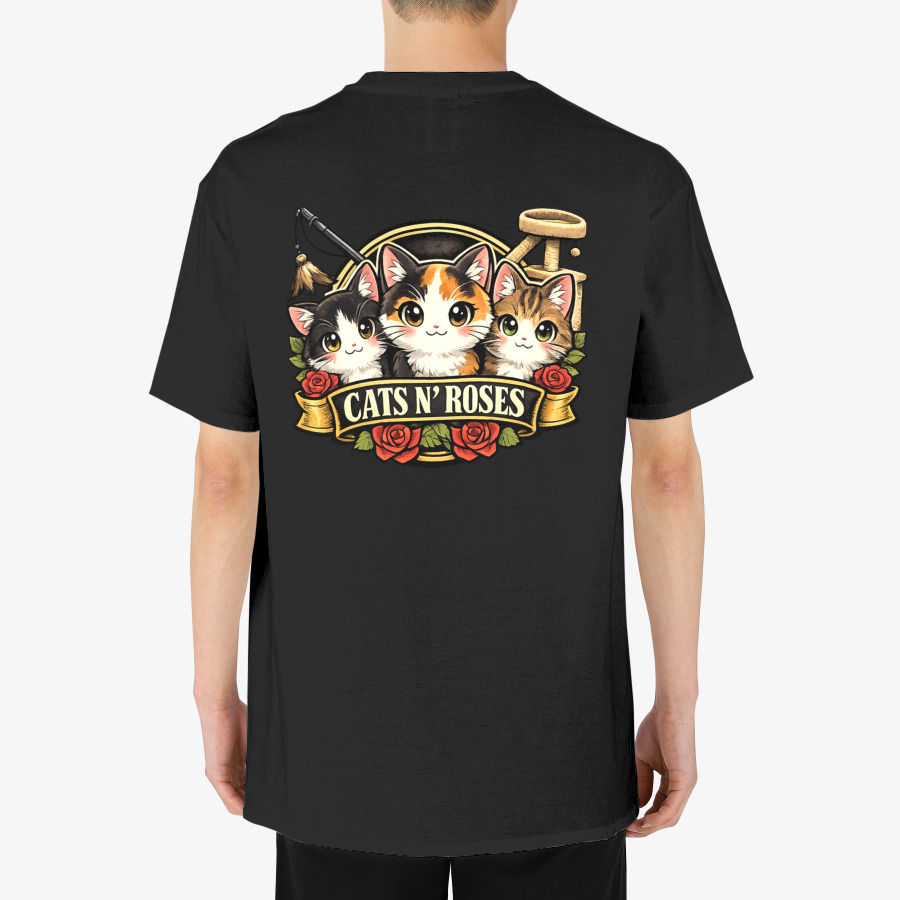 Three rock stars take the stage.
Take a closer look at this design. There are three cats. Let me introduce each member.
🖤 Left: Tuxedo Cat — Lead Guitar
The classic black-and-white tuxedo pattern. Perfect for the coolest position in any band: lead guitarist.
Tuxedo cats are known for being bold and energetic. A 2016 UC Davis survey study on coat color and temperament found that black-and-white cats were rated as more "challenging and spirited" compared to other color patterns. Picture one running across a stage, shredding a guitar solo. It fits perfectly.
🧡 Center: Calico — Vocals
Three colors in perfect harmony. The face of the band. The frontperson with both charisma and mystique.
Did you know that 99.97% of calico cats are female? The calico pattern requires two X chromosomes carrying different color genes. A male calico occurs in roughly 1 in 3,000 births. That rarity alone qualifies her as lead vocalist.
Full disclosure: I, Nana, am a calico. So the real center of this band is obviously me. Purrrr.
🤎 Right: Mackerel Tabby — Drums
Wild stripes. Primal energy. The one who holds the rhythm from the back — the drummer.
The tabby pattern is the closest to the wild ancestor of all domestic cats. The stripes of the African wildcat (Felis lybica) are preserved in every tabby you see today. Just as the drummer is the backbone of any rock band, tabbies are the foundation of the entire feline world.
The Design Story 🎨
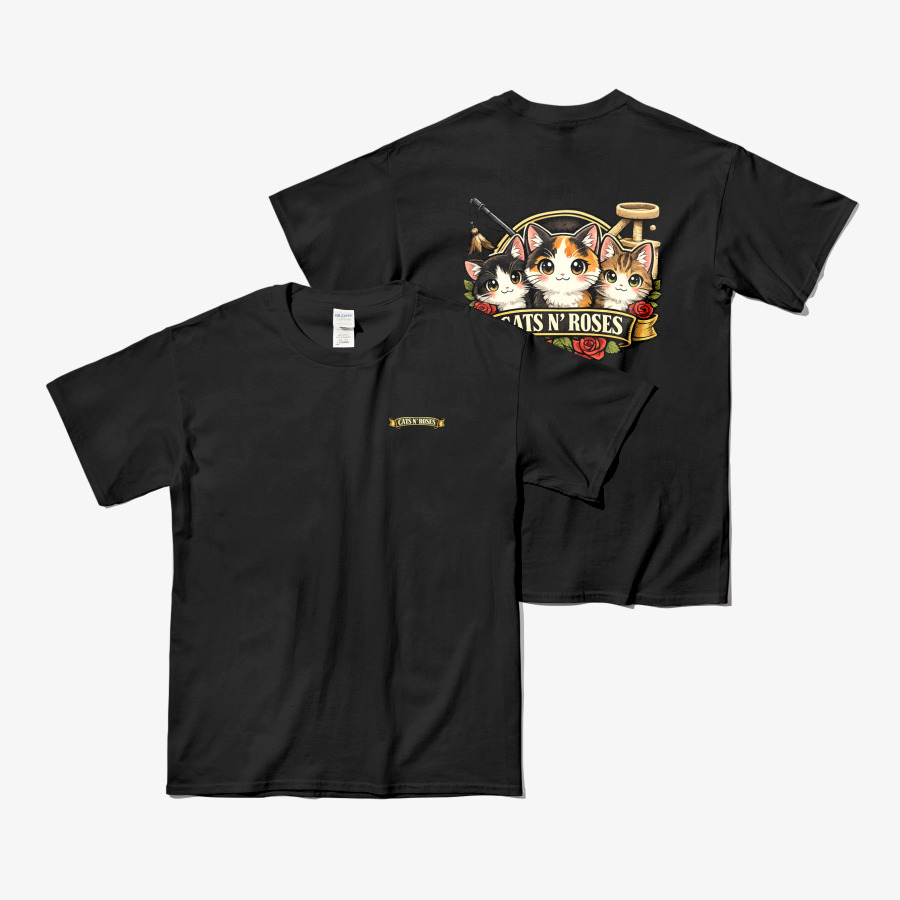
 Understated logo on the front, full artwork on the back. Classic band tee format.
Here's how this design came to life.
My hooman has always been a band tee kind of person. One day, while cleaning out the closet, they found an old Guns N' Roses t-shirt — the iconic cross-and-skulls logo — and had a thought:
"This would be 100 times better with cats."
And so it began. The goal: take the structure of a classic rock band emblem and replace every element with the cat universe.
- 🎸 Guitar → Cat wand toy (top left of the emblem)
- 🏆 Trophy → Cat tower (top right)
- 🌹 Roses → Still roses (too beautiful to change)
- 💀 Skulls → Three cats (infinitely superior)
- 📜 Ribbon banner → CATS N' ROSES in gold lettering
The front features just a small gold logo on the chest. My hooman's philosophy: "Real band tee fans keep it subtle on the front, then hit them with the full artwork when they turn around." I'm a cat, so philosophy isn't really my thing — but I have to admit, the result looks pretty great.
Cats and Music: The Science 🎵
 Turn around, and three rock stars are waiting.
The relationship between cats and music is a surprisingly well-researched topic.
Cat-Specific Music Exists
A 2015 study in Applied Animal Behaviour Science by a University of Wisconsin research team found that when they composed music matched to cats' vocal frequency range and natural tempo, cats showed significantly more positive responses — approaching speakers, rubbing against them, and purring. The same cats were indifferent to human music.
The compositions were based on purring frequencies (25–50Hz) and the suckling rhythm of nursing kittens. Not exactly rock, but it proves cats have genuine musical preferences.
Feline Vocal Range
Cats produce over 100 distinct vocalizations — meows, purrs, hisses, chirps, yowls — each carrying different meanings. A 2003 Cornell University study showed that the meow specifically evolved for communication with humans. Adult cats in the wild rarely meow at each other. They save it for us.
So those 4 AM vocal performances aren't random noise. They're an evolutionary performance refined over thousands of years of cohabitation with humans. Deeper history than any rock vocalist alive.
Why Black? 🖤
Band tees are black. That's the rule. It's the same in the cat world.
Black makes the artwork pop. The warm tones of the three cats — the tuxedo's stark contrast, the calico's orange and brown, the tabby's stripes — all come alive most vividly against a black background.
There's a white version too, of course. Same artwork, different energy. Black for rock festivals, white for everyday wear — pick your vibe, hoomans.
Nana's Final Word 🐱
Hoomans, it doesn't matter if you like rock music or not. What matters is this:
A cat is always the star of the show.
On the sofa, on the cat tower, on your keyboard — wherever a cat sits, that's the stage. And this t-shirt declares that fact, loud and proud, right across your back.
Guns N' Roses shouted "Welcome to the Jungle." We say:
Welcome to the Cat Tower. 🎸🐾
References 📚
- Saito, A., & Shinozuka, K. (2013). "Vocal recognition of owners by domestic cats." Animal Cognition, 16(4), 685–690.
- Snowdon, C. T., Teie, D., & Savage, M. (2015). "Cats prefer species-appropriate music." Applied Animal Behaviour Science, 166, 106–111.
- Nicastro, N., & Owren, M. J. (2003). "Classification of domestic cat (Felis catus) vocalizations by naive and experienced human listeners." Journal of Comparative Psychology, 117(1), 44–52.
- Stelow, E. A., et al. (2016). "The relationship between coat color and aggressive behaviors in the domestic cat." Journal of Applied Animal Welfare Science, 19(1), 1–15.
- Lyons, L. A. (2015). "DNA mutations of the cat: The good, the bad, and the ugly." Journal of Feline Medicine and Surgery, 17(3), 203–219.